 Packing up an entire household is a lot of work, and most people do not realize how much they actually own until every last item has to be wrapped, boxed, and carried out the door. Some rooms come together in an afternoon. Others turn into a multi-day project that keeps expanding the closer moving day gets. Knowing which room deserves the most planning time in advance is one of the simplest ways to avoid a last-minute scramble.
Quick Answer: Which Room Is Hardest to Pack?
The kitchen is the hardest room to pack for most households because it holds a high volume of fragile, oddly shaped, and frequently used items that all need protection and organization at the same time. Bathrooms and garages tend to rank as the next most difficult, while bedrooms and living rooms are usually the most straightforward.
Which Room Is Genuinely the Hardest to Pack?
The kitchen consistently ranks as the most difficult room in a home to pack because it combines three problems that rarely overlap this heavily in any other room: fragility, irregular shapes, and daily use right up until moving day. A bedroom closet might have a lot of clothes, but clothes pack easily and forgive a little disorganization. A kitchen drawer full of mismatched lids, glassware, and small appliances does not offer that same flexibility.
Anyone who opens a few kitchen cabinets and drawers with fresh eyes can see the scope of the problem. Small tools and supplies accumulate for years without much thought, and none of that becomes obvious until it all has to come off the shelf and into a box at the same time.
Why Does the Kitchen Cause More Packing Problems Than Any Other Room?
The kitchen creates more packing challenges than other rooms because it concentrates fragile items, inconsistent shapes, heavy loads, and daily-use essentials into one relatively small space. Four specific issues show up again and again.
- Fragile items abound. Glasses, mugs, and small appliances all need individual protection to survive transit without cracking or shattering.
- Awkward shapes. The easiest items to pack are regular and consistent in shape. Kitchens are full of the opposite: pots, pans, and utensils in wildly different sizes that never stack cleanly.
- Heavy boxes. Dishware and cookware add up fast in weight. A box that looks half full can still be too heavy to lift safely if it is packed with stoneware or cast iron.
- Items used regularly. Most rooms can be packed weeks in advance since the contents sit unused anyway. The kitchen resists that approach, since at least some cookware and dishes usually stay in rotation until the final days before the move.
What Makes Kitchen Boxes So Prone to Damage?
Kitchen boxes get damaged more often than boxes from other rooms because uneven weight distribution and unprotected edges create pressure points that a truck’s normal vibration and shifting can exploit over a multi-hour drive. A box packed with heavy plates on top of lightweight glassware, for example, is a box that arrives with broken glassware, even if nothing dramatic happened during the move itself. Experienced packers place the heaviest items on the bottom, cushion every layer, and never let one box exceed a weight that becomes unsafe or unstable to lift.
Which Other Rooms Tend to Cause Trouble?
Bathrooms and garages rank just behind the kitchen in packing difficulty because both rooms mix liquids, tools, and irregularly shaped items that do not fit neatly into standard boxes. Bathrooms present a smaller version of the kitchen’s problem: bottles, medications, and personal care items that are awkward to pack and often needed until the very last morning. Garages bring a different kind of challenge, with tools, chemicals, and sporting equipment that vary wildly in shape and sometimes cannot travel on a moving truck at all due to safety regulations around hazardous materials.
Which Rooms Are Actually the Easiest to Pack?
Bedrooms and living rooms are typically the easiest rooms to pack because most of their contents are soft, stackable, or large single pieces rather than a collection of small, fragile items. Clothing, linens, and books pack efficiently into uniform boxes, and furniture in these rooms usually just needs disassembly and padding rather than the kind of careful, item-by-item wrapping a kitchen demands. That relative simplicity is exactly why these rooms are safe to pack weeks in advance, while the kitchen should stay near the top of the priority list.
What Packing Techniques Actually Reduce Kitchen Packing Stress?
Using smaller boxes and packing in shorter, more frequent sessions reduces kitchen packing stress by keeping individual box weight manageable and preventing the kind of overwhelm that comes from trying to tackle an entire kitchen in one sitting. It takes more boxes overall, but each one stays light enough to carry safely and is far less likely to break apart under its own weight or crush something placed underneath it during loading.
This is also the right room to use as a decluttering opportunity. Duplicate can openers, chipped dishes, and small appliances that have not been used in years are worth setting aside before packing rather than paying to move and unpack them again. A quick, honest pass through the kitchen inventory usually turns up more of this than expected.
How Should Fragile Dishware Be Packed to Survive the Move?
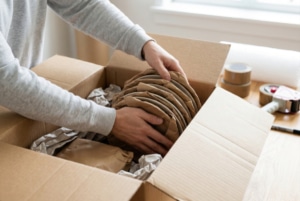
Fragile dishware survives a move best when plates are packed vertically like records rather than stacked flat, and when every piece gets its own layer of wrapping before it goes into the box. Plates packed on their edge distribute impact differently than a flat stack, which is why professional packers consistently use this method for dinnerware. Glasses and stemware need paper or bubble wrap stuffed inside as well as around the outside, since the inside of a glass is often the first place a crack starts if it takes an impact during transport.
“People are always surprised by how much time the kitchen takes compared to every other room in the house,” said Bryan Jones, Owner of Steele & Vaughn. “We tell customers to treat the kitchen like its own small project. Start it early, use smaller boxes, and do not save it for the last night before the move.”
When Should Kitchen Packing Start Relative to Moving Day?
Kitchen packing should begin early enough to box up rarely used items first while leaving only a small set of daily essentials for the final one to two days before the move. Items like specialty bakeware, holiday dishes, and small appliances that only come out occasionally can be packed weeks in advance. What is left for the final stretch should be limited to a few plates, cups, and basic cooking tools, which keeps the kitchen functional right up until moving day without leaving a full room’s worth of packing for the end.
How Does Local Housing Stock Affect Kitchen Packing in the Greensboro Area?
Older homes throughout the Greensboro area often have smaller kitchens with less built-in cabinetry than newer construction, which means more freestanding storage, more small appliances kept on countertops, and often more total items to pack relative to the size of the room. Newer homes and new construction communities around the Triad tend to have larger pantries and more built-in storage, which can spread items out more but does not necessarily reduce the total packing workload. Either way, humidity during the warmer months is worth factoring into packing timing, since cardboard left in a hot garage or an uncooled moving truck for too long can soften and weaken faster than expected.
Should Professional Movers Handle the Kitchen Packing?
Professional movers are often worth hiring specifically for the kitchen, even for households handling the rest of the move independently, because trained packers know how to protect fragile and oddly shaped items far faster and more reliably than most households manage on their own. A kitchen packed by an experienced crew tends to arrive with fewer broken items and takes a fraction of the time it would take a household doing it after work or on a single weekend.
Steele & Vaughn has served the Greensboro area since 1934 and offers full packing services in addition to local, long-distance, and specialty moving support. A team that packs kitchens every week has already solved the problems that catch most households by surprise, from how to protect stemware to how to keep a box of cast iron from becoming unsafe to lift.
What This Means for Anyone Packing Up a Kitchen
The kitchen deserves more time and attention than any other room in the house, simply because it holds the highest concentration of fragile, awkwardly shaped, and frequently used items. Starting early, packing in smaller boxes, and using the process as a chance to declutter all make the job more manageable than trying to power through it in one exhausting push near the end of a move.
Anyone preparing for a move in the Greensboro area who wants help with the kitchen, or with the rest of the house, can reach out to Steele & Vaughn to schedule a free estimate and put a piece of the workload in experienced hands.
Frequently Asked Questions About Packing a Kitchen
Why is the kitchen harder to pack than other rooms? The kitchen combines fragile items, irregularly shaped cookware, heavy dishware, and daily-use essentials in a way no other room does. That combination means more time spent wrapping individual items and more caution needed to avoid overloading boxes, which adds up to more total effort than a room full of clothing or books.
How many boxes does an average kitchen need to pack? Most kitchens require between 15 and 25 boxes, depending on the size of the household and how much cookware, dishware, and small appliances are being moved. Using smaller boxes for heavier items increases the total box count but keeps each one safer to lift and less likely to break during transport.
What is the best way to pack plates for a move? Plates travel best when packed vertically, similar to records in a crate, rather than stacked flat on top of each other. Wrapping each plate individually and using a divided box or heavy padding between plates further reduces the risk of chips and cracks during loading and transport.
Should dishes be packed in dish barrels or regular boxes? Dish barrels, which are thicker and taller than standard moving boxes, offer better protection for fragile dishware, though a sturdy medium box with generous wrapping and padding can also work well. What matters most is limiting the weight in any single box and cushioning every layer, regardless of which container is used.
How far in advance should kitchen packing start? Rarely used kitchen items, such as holiday dishes, specialty bakeware, and small appliances that only come out occasionally, can be packed several weeks before a move. Daily-use items like a few plates, cups, and basic cooking tools should stay accessible until one or two days before the move.
What kitchen items should not go in a moving box? Propane tanks, cleaning chemicals, and other hazardous materials typically cannot be transported by professional movers and need separate disposal or transport. Perishable food should be used up, donated, or discarded before moving day rather than packed, since it can spoil in transit and create odor or pest problems.
Is it worth hiring professional packers just for the kitchen? Yes, for many households. Hiring professionals for the kitchen specifically, while handling other rooms independently, is a common way to save money without giving up the protection that experienced packers provide for the most breakage-prone room in the house.
How should small appliances be packed for a move? Small appliances travel best in their original boxes when available, since those boxes are designed with proper internal padding for that exact shape. When the original packaging is not available, wrapping the appliance in a towel or blanket and securing it inside a snug box prevents movement during transport.
What is the easiest room to pack when moving? Bedrooms and living rooms are typically the easiest rooms to pack, since most of their contents are soft, stackable items like clothing and linens, or large furniture pieces that mainly need disassembly and padding rather than individual wrapping. These rooms are safe to pack weeks ahead of a move without much risk.
Does decluttering the kitchen before a move actually save money? Yes. Fewer items mean fewer boxes, less weight, and less time spent packing and unpacking, all of which reduce the total cost of a move when pricing is based on volume, weight, or hours worked. Getting rid of duplicate tools, chipped dishes, and unused small appliances before packing begins is one of the simplest ways to lighten a kitchen move.
The post What Is the Hardest Room to Pack When Moving? appeared first on Steele & Vaughn.
from
https://steeleandvaughn.com/what-is-the-hardest-room-to-pack-when-moving/


No comments:
Post a Comment